• Welcome To Amputee Care Center

  • powered by Spronken

Walking on different surfaces

Walking on different surfaces

Move confidently and comfortably in any situation

Walking seems easy until the surface changes. Sidewalks, gravel paths, grass, and forest floors all require different things from the body. For people with a leg prosthesis, this means that balance, stability, and confidence are constantly being challenged. With the right prosthesis, careful adjustment, and good guidance, it is possible to continue moving safely and comfortably even on changing surfaces.

At Amputee Care Center, we guide people every day who encounter different surfaces at home, at work, or in their free time. During your rehabilitation, we provide intensive guidance with walking training.

Book an introductory meeting

Book an introductory meeting with a delicious cup of coffee!

Contact us by completing the Contact Form or by calling +32 (0)470 500 888. We are at your service.

Why different surfaces impose additional demands

Every surface reacts differently to movement. A flat floor is predictable. The foot always lands in the same way and the body can easily repeat the walking pattern. Outdoors, it's different. Grass, sand, gravel, or uneven paving cause small unexpected changes with every step.

The body has to respond to this constantly. Muscles correct more quickly, joints absorb shocks differently, and the balance system is used more actively. This is partly controlled by proprioception: the ability to sense where the body is and how it is moving.

For someone with a prosthesis, this means that shocks are distributed differently and that the foot and body must constantly adapt. An adjustment that feels comfortable indoors may feel unstable outdoors. Especially when the surface is soft, uneven, or sloped, the position of the foot changes with every step.

This has three important consequences:

  1. Changed distribution of force: The ground reaction force does not come straight up, but at varying angles. This requires more correction from muscles and joints higher up in the chain, such as the knee, hip, and torso.
  2. The role of stabilizing muscles increases: Small corrections must be made more quickly to maintain balance. With a prosthesis, this active correction is particularly important because the prosthesis itself has no muscle function.
  3. The timing of the movement changes: On soft surfaces such as sand or grass, the foot sinks slightly, making the push-off less efficient and walking feel more difficult.

Common surfaces and their challenges for amputees

Hard and uneven surfaces

Cobblestones, sidewalks, and forest paths cause small but constant differences in height. The prosthetic leg must sufficiently absorb these shocks without becoming unstable. Too little cushioning can lead to strain on the knee, hip, or lower back. Too much cushioning can cause a delayed and uncertain gait.

Soft surfaces

Grass, sand, and mud require more energy. The foot sinks, reducing the power of the push-off. This requires a good balance between flexibility and support. A foot that is too stiff makes it difficult to adjust, while a foot that is too flexible can reduce the feeling of control.

Sloping surfaces and ramps

Sloping sidewalks and ramps require adjusted alignment. The position of the prosthetic foot in relation to the lower leg is crucial here. Even a slight deviation can lead to a feeling of sinking inward or outward, resulting in additional strain on the body.

Discover new possibilities!  Modifications to your prosthetic leg

Prosthetic feet, knees, and sockets can be modified with technologies such as hydraulic systems, microprocessor control, and adjustable materials to improve stability on uneven terrain, slopes, and slippery surfaces; research suggests that these features reduce fall risks and increase mobility, although effectiveness varies by user and activity level.

These components can be combined into your personalized prosthesis at a specialized prosthetic center, such as the Amputee Care Center (by Spronken). Future innovations, such as sensor-based systems, promise even greater adaptability. Such modifications allow users to experience greater freedom and confidence in their daily lives.

Prosthetic feet: adapting to uneven ground

Prosthetic feet with multi-axial or hydraulic mechanisms adapt to varying surfaces, such as grass or stones, for better balance. Examples include the WillowWood meta Flow, which offers active dorsiflexion to prevent tripping, and the Fillauer Slope Adaptive Foot, which adapts to slopes for natural steps.

Prosthetic feet are the primary point of contact with the ground and are crucial for stability. Adjustments such as split heels, hydraulic damping, and active dorsiflexion provide better ground compliance, rollover, and balance on surfaces such as grass, cobblestones, slopes, or slippery paths. 

  • Recent innovations, such as the WillowWood META Flow, offer active dorsiflexion during the swing phase to lift toes and prevent tripping, with a 14° ankle range for smooth transitions on uneven terrain. The Fillauer Slope Adaptive Foot (SAF) adapts to slopes, increases toe clearance for safety, and reduces energy expenditure, as demonstrated in clinical trials with veterans.
  • Other models, such as the SoftFoot Pro, are flexible and waterproof for slippery or uneven ground, while hiking-specific feet offer multi-axial flexibility for rough terrain. 

These feet support prosthetic leg users weighing up to 166 kg and are suitable for K3-K4 activity levels, offering benefits such as 95% energy return and low maintenance requirements. Clinical studies highlight improved gait and daily activities, although some models perform better in specific areas.

Prosthetic knees: stability on sloping and varying surfaces

MCK or microprocessor knees adjust in real time to speed and terrain. Össur's Rheo Knee offers automatic adjustments for a natural gait pattern, while Blatchford's Orion3 provides real-time hydraulic resistance for stability when walking and on slopes.

MCK electronic knees are suitable for activity levels from K1 to K4, with clinical evidence for improved safety, efficiency, and user satisfaction. For low mobility, models such as LegWorks All-Terrain Knee offer additional support. 

Prosthetic sockets: adjustable fit for consistent stability

Adjustable sockets, such as Click Medical's RevoFit with dial adjustments, accommodate volume changes for a better fit, which increases stability on various terrains through pressure distribution and comfort. 3D printing technology ensures an improved fit.

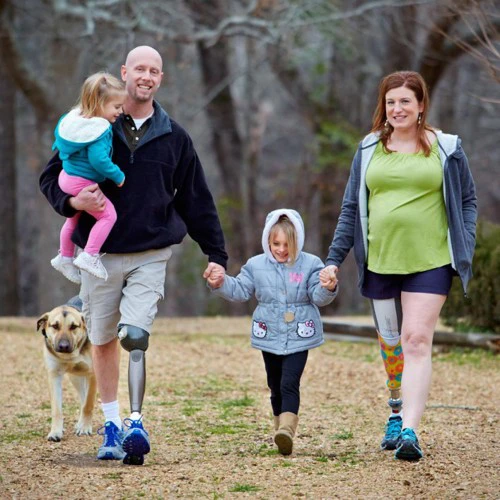
Man walking with a prosthetic leg

Ask your expert leg prosthesis specialist for advice

As experts in leg prostheses, we at the Amputee Care Center (Genk, Belgium) know how crucial stability is for amputees who navigate different surfaces every day, from urban sidewalks to natural, sloping paths. We are happy to advise you. Make an appointment and discover new possibilities!

Book an introductory meeting

Book an introductory meeting with a delicious cup of coffee!

Contact us by completing the Contact Form or by calling +32 (0)470 500 888. We are at your service.

Core adjustments for stability in leg prostheses

Prosthetic components are becoming increasingly advanced, with technologies such as sensors, hydraulic damping, and adjustable mechanisms that respond in real time to changes in terrain. 

  • For feet, adjustments include multi-axial movements and active dorsiflexion to conform to uneven ground, reducing fall risks and increasing energy efficiency.
  • Knees use microprocessor control for adaptive flexion and extension, ideal for slopes and varying speeds, while sockets offer adjustable systems to address volume fluctuations, ensuring a consistent fit for better balance. 

These adjustments are particularly useful for active users (K3-K4 levels), but also for lower mobility, with clinical studies demonstrating improved mobility and satisfaction on various surfaces. However, factors such as weight limits, maintenance, and cost play a role, and professional fitting is essential to achieve optimal performance.

The role of the leg prosthesis when walking on varying surfaces

A leg prosthesis that is suitable for different surfaces combines stability with flexibility. Shock absorption helps to reduce stress on joints and muscles. At the same time, sufficient freedom of movement is needed to be able to roll naturally and accommodate small adjustments.

The choice of foot plays an important role in leg prostheses. The foot construction determines how well the prosthesis can adapt to varying surfaces. Some feet offer more multi-axial movement, allowing them to move better with uneven terrain.

Shock absorption affects how forces are transmitted to the body. This is essential when walking on hard or uneven surfaces. The alignment of the ankle, knee, and foot determines how stable a person feels, especially on sloping surfaces and transitions.

Want to know more? We would like to invite you for a no-obligation introductory meeting to discuss the possibilities.

Book an introductory meeting

Book an introductory meeting with a delicious cup of coffee!

Contact us by completing the Contact Form or by calling +32 (0)470 500 888. We are at your service.

Building confidence through training and familiarization

In addition to the right prosthesis, training is essential. Walking on different surfaces is not something you learn in one go. By practicing in a safe and controlled environment, such as the Amputee Care Center prosthesis center, your body learns how your prosthesis responds to changes in the surface. We call this process neuromuscular adaptation.

Targeted walking training helps improve your balance, coordination, and muscle control. This reduces the risk of uncertainty or falling. We often start with slightly uneven surfaces and gradually build up to more complex situations. In this way, confidence grows step by step along with skill.

Personalized care makes all the difference

Every amputation, prosthesis, and way of moving is different. That's why good guidance always starts with a personal introductory meeting at Amputee Care Center. Our specialized prosthetist looks at your daily environment, activities, and goals. If you walk a lot outside, at work, or in nature, that requires different choices than if you mainly move indoors.

During check-ups, we pay attention to comfort, stability, and how the prosthesis behaves on different surfaces. Where necessary, we adjust the settings or discuss alternatives that better suit your situation. In combination with targeted walking training, we work on a safe and natural way of moving, tailored to your daily environment and activities.

Confident movement in everyday life

Walking on different surfaces is part of everyday life. With the right prosthesis, proper adjustment, and guidance, it is possible to continue moving confidently outdoors, on uneven terrain, or on varying surfaces. The goal is not only to be able to walk, but to do so comfortably and with confidence.

Support from Amputee Care Center

At Amputee Care Center, we believe it is important that movement remains comfortable in everyday life, even when circumstances change. We are here to provide you with support and prosthetic solutions that suit your way of moving.

Are you curious about what is possible in your situation, or do you find that walking on certain surfaces feels unstable? Feel free to contact us, even for a free second opinion. We are happy to think along with you and guide you step by step.

Book an introductory meeting

Book an introductory meeting with a delicious cup of coffee!

Contact us by completing the Contact Form or by calling +32 (0)470 500 888. We are at your service.

WhatsApp